Fandango Checkout Breach Exposed 69,665 Payment Cards.
Fandango reported an October 8-11 checkout breach exposed card numbers, CVVs, and emails for 69,665 people.
RIKEN disclosed a Fugaku intrusion exfiltrated 430 credentials including 233 SSH keys without passphrases.
RIKEN confirmed on 20 November 2026 that an attacker who breached Fugaku and RIKYU supercomputers between 10 and 13 November exfiltrated 430 authentication credentials from user home directories, including SSH private keys for external systems. Of these, 233 had no passphrase and 197 had passphrases. RIKEN is treating all 430 as compromised and asking users to revoke and reissue keys.
RIKEN, Japan's national research institute, confirmed on 20 November 2026 that an attacker who breached the Fugaku supercomputer between 10 and 13 November collected and exfiltrated 430 authentication credentials from user home directories. In its second notice, the institute says the credentials include SSH private keys that users stored on Fugaku to log in to other organizations' supercomputers and cloud services. Of the 430 credentials, 233 private keys had no passphrase and 197 had passphrases. RIKEN is treating all of them as compromised and is contacting affected users individually to request that they revoke and reissue the keys at each external connection point.
High High because stolen SSH keys without passphrases can be used immediately by anyone who holds them, and passphrase-protected keys may still be crackable offline, giving attackers potential access to other institutions' high-performance computing resources.
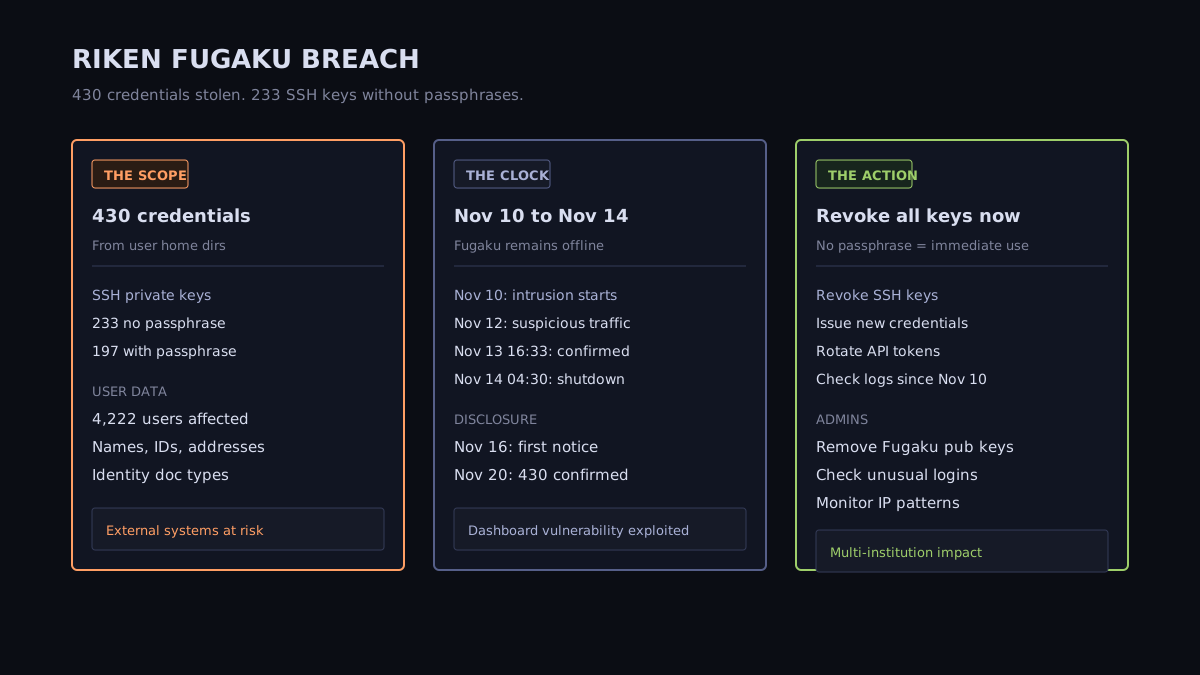
Fugaku is one of the world's most powerful supercomputers, operated by RIKEN's Center for Computational Science. Between 10 and 13 November 2026, an outside attacker used a web dashboard that showed Fugaku's operating status and was exposed to the internet as a foothold into the internal operations network, RIKEN's first notice on 16 November stated. The institute referred to a software vulnerability that was exploited but has not named the vulnerability or the dashboard software publicly.
| Event | Date and Time (Japan Time) |
|---|---|
| First unauthorized activity traced | 2026-11-10 |
| Suspicious network traffic detected | 2026-11-12 |
| Unauthorized access confirmed | 2026-11-13, 16:33 |
| System used for intrusion isolated | 2026-11-13, evening |
| Fugaku operations stopped, external access cut | 2026-11-14, 04:30 |
| Admin keys replaced, user login keys disabled | 2026-11-15 |
| Second notice: 430 credentials confirmed exfiltrated | 2026-11-20 |
RIKEN worked with its outsourced maintenance contractor to investigate suspicious traffic on 12 November and confirmed unauthorized access at 16:33 on 13 November. The institute isolated the compromised system that evening, stopped Fugaku, and cut off outside access at 04:30 on 14 November. On 15 November, it emailed users, disabled every user's login public key, and stopped all running and queued jobs. CyberSixt reports that the attackers operated several servers inside the network and planted malicious programs on some of them.
RIKEN's 20 November update confirmed that 430 authentication credentials used to connect to external systems were collected and exfiltrated from user home directories. The breakdown:
HPCwire reports that RIKEN found evidence of external connections involving some credentials but has not identified other instances of misuse. However, because SSH private keys can be copied and used repeatedly, RIKEN is implementing emergency measures on the assumption that all 430 credentials have been compromised.
RIKEN's investigation also found traces indicating that the attacker accessed personal information for 4,222 Fugaku users. The institute is treating this data as potentially compromised. Information entered during account registration that may be affected includes:
RIKEN says no leakage of the identity-verification documents themselves has been confirmed. AI.info notes that RIKEN has seen no evidence of external misuse of the personal information but is taking the access traces seriously.
For Fugaku users:
For administrators of other systems:
Administrators of supercomputers, cloud services, and compute clusters that Fugaku users connect to should:
authorized_keys files. Assume any key a user had on Fugaku is compromised.RIKEN has reported the incident to the Saitama and Hyogo prefectural police and is establishing an investigative committee with external experts. The institute says the timing of Fugaku's resumption will be determined after implementing measures to prevent recurrence, such as separating public services from the administrative network and rebuilding the servers. No evidence of a public dump or resale of the stolen credentials has been reported yet, but the keys without passphrases can be used by whoever holds them right now.
RIKEN says it has no concrete evidence so far that research results leaked. The confirmed exfiltration covers authentication credentials from user home directories and personal registration data, not the scientific datasets processed on the supercomputer.
Remove SSH public keys that were stored on Fugaku from authorized_keys files, rotate API keys and access tokens issued to Fugaku users, and check logs for logins from unfamiliar locations or IP addresses since 10 November.
RIKEN says the attacker exploited a software vulnerability in a web dashboard that displayed Fugaku's operational status and was exposed to the internet. The vulnerability and dashboard software have not been named publicly.
Fandango reported an October 8-11 checkout breach exposed card numbers, CVVs, and emails for 69,665 people.
Peach disclosed Yumirulink's Cuenote FC breach exposed 8.99M records including names, addresses, and itineraries.
Plaid confirmed a 13 November intrusion into KARTE exposed 570 clients including MUFG, SMBC, ZOZO, Suntory, and J.League.