Fandango Checkout Breach Exposed 69,665 Payment Cards.
Fandango reported an October 8-11 checkout breach exposed card numbers, CVVs, and emails for 69,665 people.
Plaid confirmed a 13 November intrusion into KARTE exposed 570 clients including MUFG, SMBC, ZOZO, Suntory, and J.League.
On 13 November 2026, an attacker exploited a vulnerability in Plaid's KARTE platform, exfiltrating data from 570 client companies across Japan, including MUFG, SMBC, ZOZO, Marui, Suntory, DHC, Sharp, Canon Marketing, Goldwin, Recruit, and J.League. Clients reported over 140 million exposed records. Plaid shut KARTE down fully and targets a staged restart in mid-January 2027.
On 13 November 2026, an attacker breached Plaid's KARTE customer-data platform, reaching data held on behalf of 570 client companies across Japan. Plaid announced on 20 November that it had finished investigating the breach and confirmed the scope included customer data uploaded by clients, user-behaviour analytics, cached identifiers, and credentials for 754 external-service integrations. KARTE has been offline since 13 November, and Plaid now targets a staged restart in mid-January 2027 after structural system changes and a third-party security review.
High High because a single vendor consolidated customer data across hundreds of major Japanese brands, banks, retailers, and service providers, exposing over 140 million records when clients reported their own tallies.
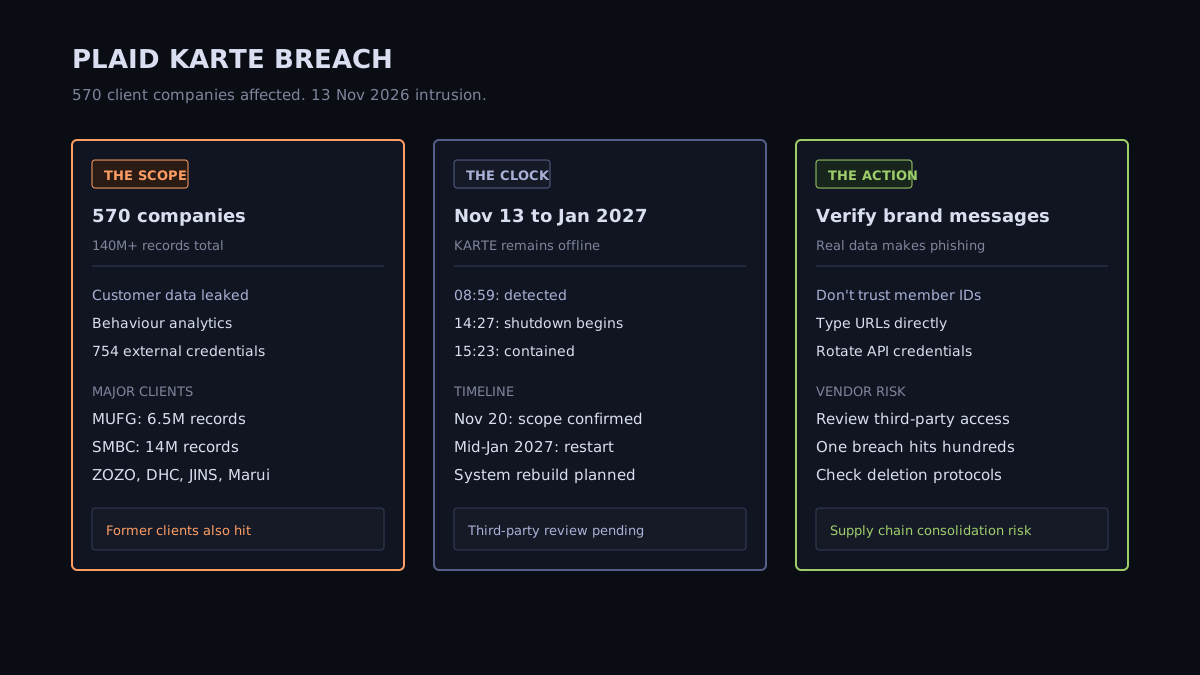
KARTE is a customer-experience platform that lets companies personalize website messages and track user behaviour. Clients upload their own customer data into KARTE, which then displays targeted content on their sites and apps. In the early hours of 13 November 2026, an attacker repeatedly tried several entry routes into Plaid's systems and finally exploited a vulnerability in internal processing behind a public route used to retrieve data, according to Plaid's 20 November report. The attacker took data through that flaw, including credentials, and used those credentials to log in to the KARTE admin console.
| Event | Date and Time (Japan Time) |
|---|---|
| Attacker tries multiple entry routes | 2026-11-13, early hours |
| Plaid detects intrusion | 2026-11-13, 08:59 |
| Plaid begins shutting down servers | 2026-11-13, ~14:27 |
| Containment finished, KARTE fully offline | 2026-11-13, ~15:23 |
| Plaid cancels stolen credentials, blocks attacker | 2026-11-13 |
| Plaid investigation complete, scope confirmed | 2026-11-20 |
| Staged restart target | Mid-January 2027 |
Plaid cancelled the stolen credentials, blocked the attacker's traffic, and switched all KARTE services into maintenance mode. The company reported the incident to Japan's Personal Information Protection Commission and said it has not seen new unauthorized access since the block. CyberSixt reports that Plaid admitted data from former clients who ended their contracts was still stored because of failures in human operations and management, though it should have been deleted under the terms.
Plaid confirmed four categories of leaked information in its 20 November filing:
Because some companies fall into more than one category, the totals cannot be added. Affected brands span major banks, retailers, e-commerce, healthcare, housing, entertainment, and consumer goods. Client disclosures reported so far add up to over 140 million records, though one person can appear across multiple clients.
Major clients have published their own breach notices with specific data types and counts:
Other confirmed affected brands include Suntory, Canon Marketing Japan, Goldwin, Recruit, and J.League.
Plaid says it will conduct a third-party forensic investigation and implement recurrence-prevention measures, including better information-deletion protocols for ended contracts. The staged restart in mid-January 2027 is a target and may change if further security work is needed.
No. MUFG and SMBC both confirmed that account numbers, PINs, passwords, and credit-card details were not involved. However, Marui Group reported that about 60,000 EPOS cardholders' declared annual income and cash-advance limits were exposed.
KARTE is a customer-experience platform that holds data on behalf of hundreds of client companies. Each client uploads its own customer data into KARTE to personalize website messages and track user behaviour. A single intrusion into Plaid's infrastructure reached data across all these clients.
Plaid targets a staged restart in mid-January 2027. The company says it is rebuilding system architecture and engaging a third-party security review rather than just patching the entry point.
Fandango reported an October 8-11 checkout breach exposed card numbers, CVVs, and emails for 69,665 people.
Peach disclosed Yumirulink's Cuenote FC breach exposed 8.99M records including names, addresses, and itineraries.
RIKEN disclosed a Fugaku intrusion exfiltrated 430 credentials including 233 SSH keys without passphrases.