Peach Aviation Confirms 8.99 Million Records Leaked Through Email Vendor.
Peach disclosed Yumirulink's Cuenote FC breach exposed 8.99M records including names, addresses, and itineraries.
Fandango reported an October 8-11 checkout breach exposed card numbers, CVVs, and emails for 69,665 people.
Fandango disclosed a checkout-page incident from 8 to 11 October 2026 exposed payment-card numbers, CVVs, expiration dates, billing ZIP codes, and email addresses for 69,665 people nationwide. Names and Social Security numbers were not involved. Fandango determined the breach on 30 October and began notifying customers on 13 November, offering credit monitoring through 13 February 2027.
Fandango Media, LLC disclosed to state attorneys general in mid-November 2026 that an October checkout incident exposed payment-card details for 69,665 people nationwide. According to BreachTally's Texas AG record summary, filed on 17 November, the breach window ran from 8 to 11 October 2026, reaching customers who completed checkout transactions during those four days. Exposed data included payment-card number, CVV, expiration date, billing ZIP code, and email address. First and last name, government ID, and Social Security numbers were not involved, the customer letter states.
High High because full payment-card details including CVV were exposed, enabling immediate fraudulent purchases without needing the cardholder's name or billing address.
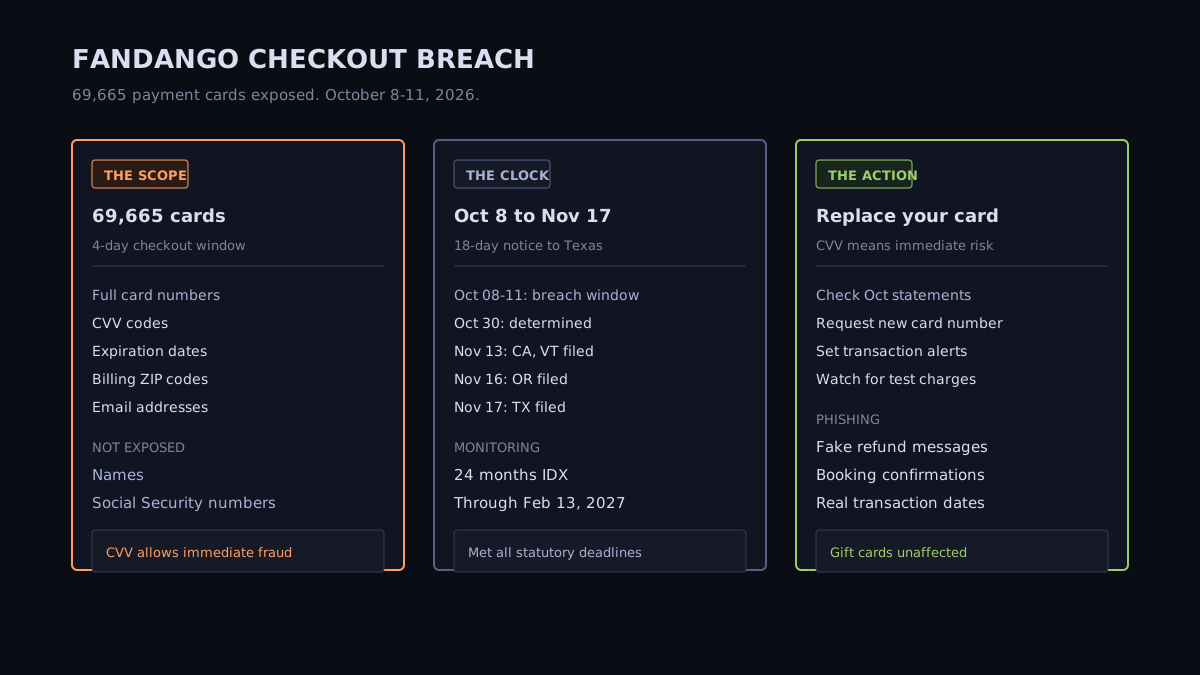
Fandango uses its checkout page to process ticket purchases for movies, live events, and entertainment bookings. BreachHistory reports that the incident affected checkout customers in the 8-11 October window, and Fandango determined the breach on 30 October 2026. The company began state filings on 13 November with California AG and continued through 17 November with Texas, Vermont, and Oregon.
| Event | Date |
|---|---|
| Breach window starts | 2026-10-08 |
| Breach window ends | 2026-10-11 |
| Fandango determines incident | 2026-10-30 |
| First state filing (California AG) | 2026-11-13 (14 days from determination) |
| Vermont AG filing | 2026-11-13 (14 days) |
| Oregon DOJ filing | 2026-11-16 (17 days) |
| Texas AG filing (69,665 nationwide total disclosed) | 2026-11-17 (18 days) |
BreachTally's case file confirms that Fandango met statutory notice periods in all four states that published records. California requires 30 days from determination, Vermont and Oregon require 45 days, and Texas requires 60 days. Fandango filed with Texas 18 days after determination, well within the 60-day limit, and with California 14 days after, meeting the 30-day statute.
The Texas AG filing lists 69,665 people affected nationwide, with 6,323 of them Texas residents. Oregon reported 913 residents, and Vermont reported 18. BreachRecord summarizes that the information exposed includes:
The notice letter explicitly states that first and last name, government ID, and Social Security numbers were not involved. However, the combination of full card number, CVV, and expiration date is sufficient to complete card-not-present transactions online without needing the cardholder's name or full billing address, which is why the severity is high.
Fandango is offering 24 months of credit and identity monitoring through IDX, running through 13 February 2027, according to BreachTally's case file. BreachHistory notes that no third party was named in the disclosure, meaning the incident appears to have involved Fandango's own systems rather than a vendor compromise.
Fandango has not disclosed the root cause or whether the intrusion method has been remediated. No public reports indicate that the stolen card data has appeared on underground markets or been used in large-scale fraud campaigns yet, but the exposure of CVVs makes immediate card replacement the safest step for affected customers.
No. According to BreachHistory, a Fandango gift-card balance without a checkout transaction in the 8-11 October window is outside the scope of this incident. Only payment cards used at checkout during those four days were affected.
No. The notice letter explicitly states that first and last name, government ID, and SSN were not involved. Exposed fields were payment-card number, CVV, expiration date, billing ZIP, and email.
Fandango determined the incident on 30 October 2026 and filed with California AG on 13 November (14 days) and Texas on 17 November (18 days). All filings were within each state's statutory notice period.
Peach disclosed Yumirulink's Cuenote FC breach exposed 8.99M records including names, addresses, and itineraries.
Plaid confirmed a 13 November intrusion into KARTE exposed 570 clients including MUFG, SMBC, ZOZO, Suntory, and J.League.
RIKEN disclosed a Fugaku intrusion exfiltrated 430 credentials including 233 SSH keys without passphrases.