Fandango Checkout Breach Exposed 69,665 Payment Cards.
Fandango reported an October 8-11 checkout breach exposed card numbers, CVVs, and emails for 69,665 people.
La Poste confirmed on 14 November 2026 that a September attack on Maileva exposed names and postal addresses of 22 million people in France.
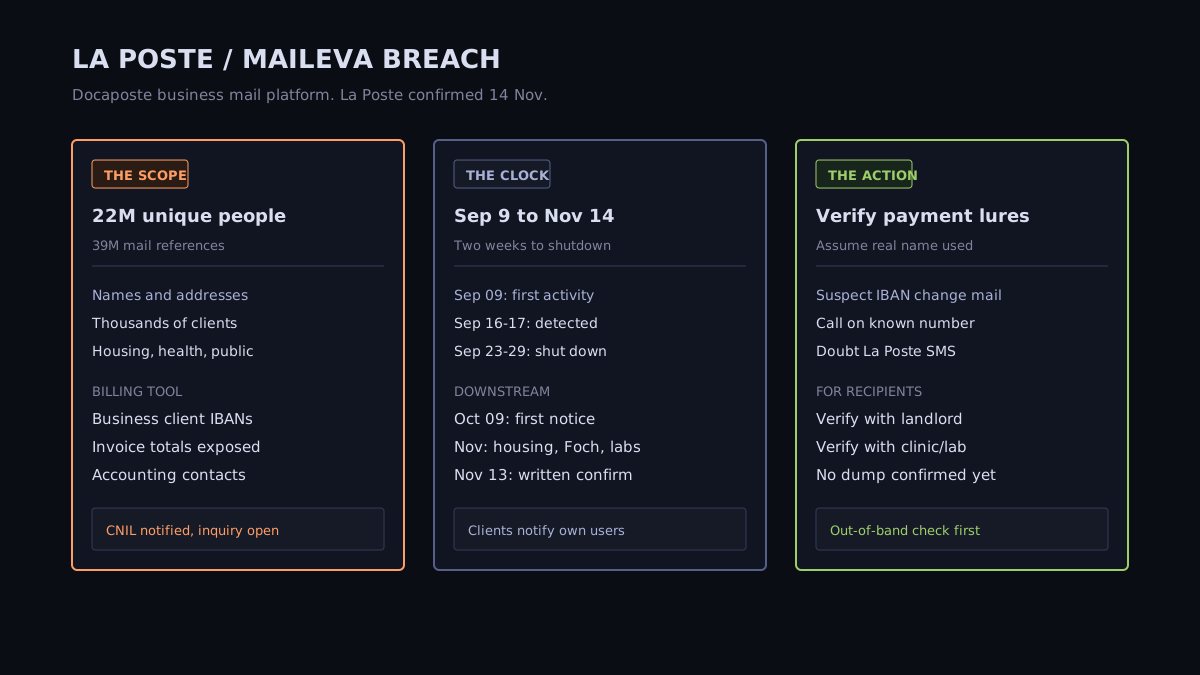
Maileva, the business mail subsidiary of La Poste's Docaposte, confirmed in mid-November 2026 that a September 2026 cyberattack exposed names and postal addresses of 22 million distinct individuals across 39 million mail references. First suspicious activity dates to 9 September, before a 23 to 29 September shutdown. Frandroid reports business client IBANs and invoice amounts were also exposed.
La Poste confirmed on 14 November 2026 that a September 2026 cyberattack on Maileva, the business mail platform of its subsidiary Docaposte, led to the theft of names and postal addresses of 22 million people. Reporting published on 13 and 14 November 2026 by Cyberattaque.org, Franceinfo, and Frandroid puts the deduplicated victim count at roughly one third of France's population, derived from approximately 39 million mail references across thousands of client organizations.
High High because a single mailing sub-processor consolidated names, postal addresses, and targeted invoice metadata across thousands of hospitals, laboratories, housing landlords, and businesses, plus corporate billing IBANs.
Maileva prints, routes, and sends administrative letters, invoices, and payment reminders for thousands of French companies, public bodies, and healthcare providers. When Maileva initially suspended its services at 07:00 on 23 September 2026, early communications framed the disruption around unauthorized access attempts against client accounts used to dispatch fraudulent mail, and services returned online on 29 September after a six-day outage.
An internal Docaposte information sheet dated 5 October and cited by Frandroid establishes an earlier intrusion window. First suspicious activity was traced to 9 September 2026, two weeks before the shutdown, and the attack itself was detected on 16 and 17 September after the intruder exploited a flaw in Maileva's software.
| Event | Date |
|---|---|
| First suspicious activity traced in Docaposte client sheet | 2026-09-09 |
| Attack detected | 2026-09-16 to 2026-09-17 |
| Preventive platform shutdown at 07:00 local time | 2026-09-23 |
| Maileva services restored after six-day outage | 2026-09-29 |
| First client breach notice (Cornouaille occupational health service) | 2026-10-09 |
| Client notices from Flandre Opale Habitat (3 Nov), Alteal (9 Nov), Inovie and Hopital Foch | Early Nov 2026 |
| Maileva written confirmation reported by Cyberattaque.org | 2026-11-13 |
| La Poste public confirmation | 2026-11-14 |
Maileva notified France's data protection regulator, CNIL, and filed a criminal complaint. A judicial inquiry is open. As of 14 November 2026, reporting notes there is no public evidence that the stolen files have been published or sold online.
Because recipients often receive letters from multiple senders through the same mailing pipeline, 39 million individual mail references collapsed to 22 million unique people after deduplication. Several client organizations have published separate disclosures illustrating the downstream chain:
Maileva does not contact individuals directly. Each client organization notifies its own customers, tenants, and patients. Expect staggered client notices and targeted payment-diversion lures to continue even without a public leak dump.
Consumer notifications from Maileva clients primarily cover names, first names, and postal addresses, with some healthcare and housing notices adding invoice amounts or care dates. Frandroid reports that the billing-tool IBAN exposure affected business client companies rather than private individuals.
Maileva prints and mails letters on behalf of thousands of client organizations. According to Frandroid, it is up to each client, such as a hospital, lab, or housing landlord, to notify its own patients, tenants, or customers, and no count of notified people exists yet.
According to an October 5 Docaposte client sheet cited by Frandroid, first suspicious activity occurred on 9 September 2026, the intrusion was detected on 16 and 17 September, and Maileva suspended services for six days from 23 to 29 September.
Fandango reported an October 8-11 checkout breach exposed card numbers, CVVs, and emails for 69,665 people.
Peach disclosed Yumirulink's Cuenote FC breach exposed 8.99M records including names, addresses, and itineraries.
Plaid confirmed a 13 November intrusion into KARTE exposed 570 clients including MUFG, SMBC, ZOZO, Suntory, and J.League.