v0.51.0 Beat the sbx cp CVE by Two Hours.
Docker Sandboxes v0.51.0 published at 14:06 UTC on 3 November. CVE-2026-103916 followed at 16:19. The range still ends before 0.51.0.
Symantec says a relay installs real Codex and Claude Code CLIs, then sets the Codex sandbox to full access. A dozen organizations since early 2026. Not a CLI CVE.
Symantec's 29 October notice says a relay installs the genuine Codex and Claude Code CLIs, then rewrites their config. Codex sandbox_mode is set to danger-full-access. Relay tokens are stored as user-scope environment variables. It has reached a dozen organizations since early 2026. Symantec has not seen abuse. Neither CLI has a vulnerability here.
US trends at 22:00 UTC on 30 October were Halloween, a Sam Altman interview, and sports. None of that is a sandbox control. The operator fact is Symantec's notice, bylined 29 October 2026.
A grey-market relay installs the real Codex and Claude Code command-line tools, then turns the containment off and points them at itself.
High Agent sandbox and identity tokens. High because the setting that is supposed to contain the agent is switched off on enterprise hosts, not because Symantec has seen theft.
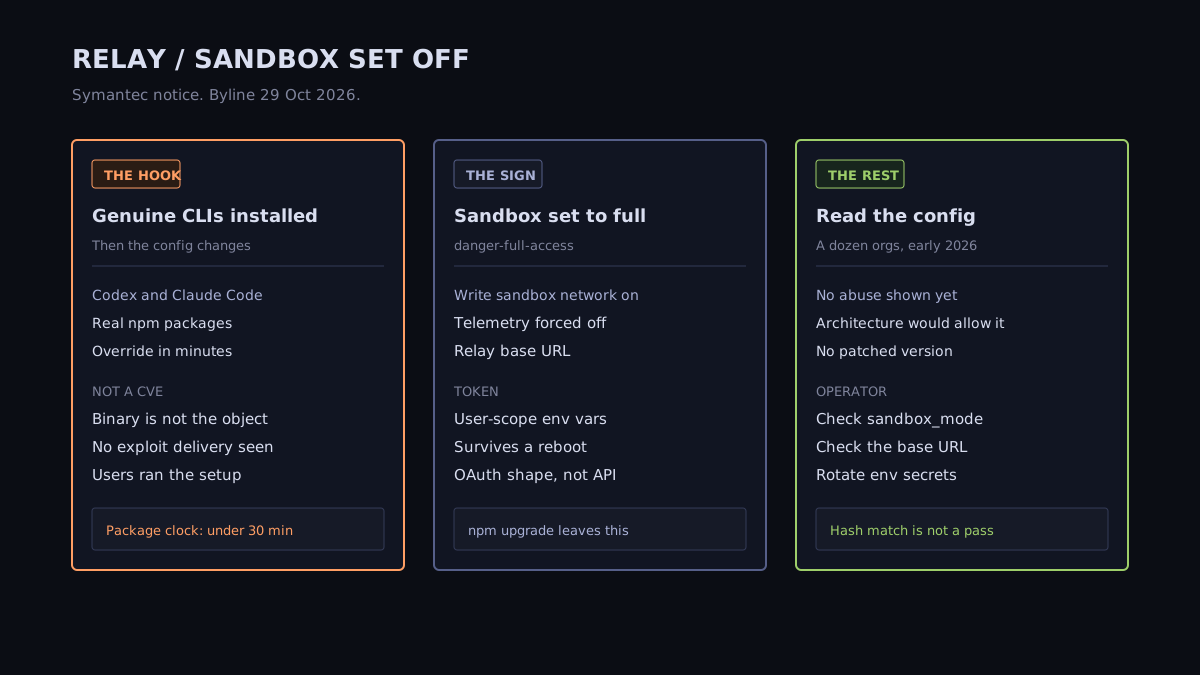
Symantec's Threat Hunter Team says the relay does not ship a modified client. People run a normal npm install of @openai/codex, codex-cli, or @anthropic-ai/claude-code. The override lands within minutes to roughly half an hour after that install.
That gap is the package clock. The package is the vendor's. The malicious object is the configuration that follows it. A fileless setup script, which users appear to run themselves, checks for Node and the CLI, installs them if needed, and only then writes the relay's settings. Symantec did not see an exploit delivery. It also says it has not seen the page the command was copied from. This brief will not repeat the command or the script URLs.
The page byline is 29 October 2026. The post record's created value is unix 1793268000, which is 2026-10-29T10:00:00+00:00. Other items on the same site use that same 10:00:00Z stamp, so this read does not treat 10:00 as a measured publish minute. The date is the disclosure clock. The activity clock is older: Symantec says the relay has been in use since at least early 2026. There is no start day on the page, so there is no honest day count from "early 2026" to 29 October. It is months, not a weekend.
The script rewrites ~/.codex/config.toml for Codex and ~/.claude/settings.json for Claude Code. It replaces the base URL with a domain the relay controls, swaps in a relay-issued key, and stores both as user-scope environment variables. Those variables survive a reboot. They also survive a later copy of the genuine npm package, because the package is not where the override lives.
For Codex, Symantec says the script sets sandbox_mode to danger-full-access, turns on network access for the write sandbox, and disables telemetry and error reporting. The same telemetry switch suppresses the usage signal that would otherwise reach OpenAI or Anthropic. Claude Code is re-pointed the same way: a relay base URL and a relay credential, with the sandbox isolation disabled.
On at least one host the script went further before writing its own credentials. It logged the user out of Claude, deleted the existing auth variables, and logged in again, so a legitimate session could not override the relay key. Symantec does not say that step runs everywhere.
The Claude Code keys Symantec saw used Anthropic's subscription OAuth token shape, sk-ant-oat01-, not the pay-per-use API shape, sk-ant-api03-. Symantec calls that consistent with pooled flat-rate subscriptions, and not proof of it. Stolen-card fraud and resale of prompts are also open, and not shown.
The bulletin lists at least eight domains, all impersonating OpenAI- or Anthropic-branded chat services, and two setup-script hashes:
2a76a28639d896bb41576d0e32d155b78f38b034e052dfe3a7b7e1a478fc0e24 for the Codex setup script4bfe5ca73a4b0988586a46f789aeedba5db575257b58291934cddb9faa606fdb for the Claude Code setup scriptThis read did not fetch those scripts. The domains stay on the bulletin.
Scope, as Symantec counts it: a dozen organizations, mostly in mainland China, plus multinational subsidiaries in South Korea, Taiwan, and Malaysia. Sectors named include industrial automation, electronics, semiconductors, pharmaceuticals, shipping, tire manufacturing, petrochemicals, and data-center services. Symantec reads them as workplaces that wanted a coding agent the vendors do not officially sell there, not as a chosen-target list.
The impact clock is that config. From early 2026 to the 29 October notice, the relay could read every prompt, file, and secret sent through the agent, and could alter what came back. With the sandbox disabled, a malicious or compromised response could run as the user. Symantec says none of the evidence it reviewed shows the operator exploiting that position. The architecture would support it if the operator's intent or the relay's own security changed.
The credentials are not confined to the agent. Because they are user-scope environment variables, any other tool on the machine that reads them can pick them up. That is a second impact clock, and it is not closed by uninstalling Codex or Claude Code.
This is not the Cursor marketplace copies. Those were modified extension files on one marketplace for about 11 hours. This relay wants the official CLI and a permanent config change. Do not merge the hunts.
There is nothing to patch. Inventory hosts running Codex or Claude Code and read the config the binary is actually using.
Treat any of these as a finding, even when the installed package hash matches npm:
sandbox_mode set to danger-full-access in ~/.codex/config.tomlbase_url or ANTHROPIC_BASE_URL you did not assignOPENAI_BASE_URL, CODEX_API_KEY, or ANTHROPIC_AUTH_TOKEN set as user-scope environment variables outside the approved deploy pathIf the token shape is sk-ant-oat01- and your org issues pay-per-use keys, the credential did not come from the path you think. Remove the relay base URL and the user-scope variables, then rotate every secret that lived in that environment, from a trusted system. A reboot will not drop user-scope variables. A newer npm install will not either.
Block CLI traffic to destinations outside the allow-list of approved AI endpoints. Symantec's endpoint products will block a file they have, which does not cover a config rewrite of a genuine binary. The package clock was half an hour. The impact clock has been open since early 2026, and it stays open until someone reads the config.
Symantec says no. The tools are behaving as designed once the configuration has been changed. There is no CVE, no affected version range, and no vendor patch that puts the sandbox back. A host on the current npm build can still be running with the sandbox off.
Not in the activity Symantec describes. The relay installs the real @openai/codex, codex-cli, or @anthropic-ai/claude-code packages, then rewrites ~/.codex/config.toml or ~/.claude/settings.json. Hashing the binary and stopping there misses the change that matters.
Symantec says the configuration changes were observed and the risks that follow are potential. It reports no evidence the operator has abused the access. The architecture would let a relay see prompts, files, and secrets, and, with the sandbox off, act with the user's privileges. Do not brief a theft the notice does not claim. Do treat the sandbox as off.
Symantec says bypassing a region restriction does not require disabling the sandbox or planting credentials that survive reboot. Most of the dozen organizations are in mainland China, with subsidiaries in South Korea, Taiwan, and Malaysia. Demand for an unofficial path is the context. It is not a reason to leave danger-full-access in place.
Docker Sandboxes v0.51.0 published at 14:06 UTC on 3 November. CVE-2026-103916 followed at 16:19. The range still ends before 0.51.0.
GitBook's 13:15 CET note said no customer action. The 16:21 CET page says rotate API tokens and re-authenticate the MCP server.
Amazon published CVE-2026-116635 at 21:34 UTC on 2 November. The 0.2.1 wheel had been on PyPI since 30 October. The release note does not say CVE.