v0.51.0 Beat the sbx cp CVE by Two Hours.
Docker Sandboxes v0.51.0 published at 14:06 UTC on 3 November. CVE-2026-103916 followed at 16:19. The range still ends before 0.51.0.
GHSA-w4c7-34wj-hqm8 published at 20:33 UTC on 27 October. PyPI litellm 1.104.8 uploaded at 19:39 UTC. Enterprise licenses only. No CVE id. OSV returned 404.
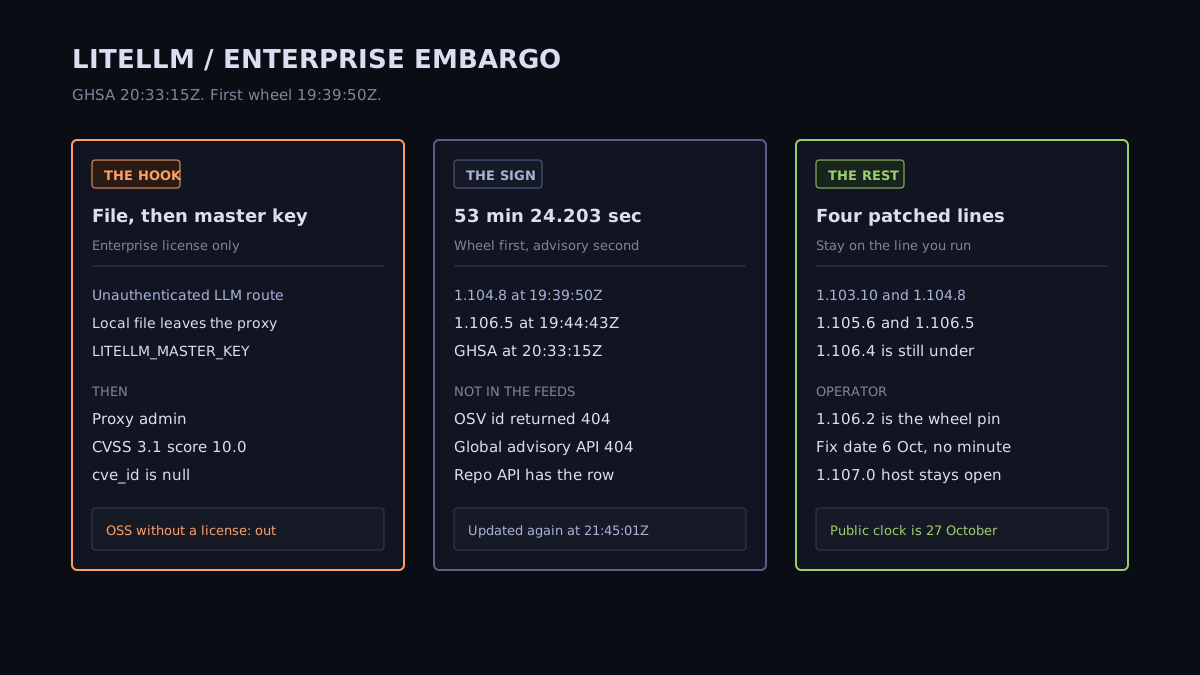
LiteLLM ended the enterprise embargo on 27 October 2026. GHSA-w4c7-34wj-hqm8 published at 20:33:15 UTC says an unauthenticated request on a licensed proxy can read a local file and expose the master key. The first public wheel, litellm 1.104.8, uploaded at 19:39:50 UTC. There is no CVE id. OSV does not list the advisory. Unlicensed open-source installs are outside this report.
US trends at 22:16 UTC on 27 October were the Colts, Buckner, and Fleetwood. Genie 4 and GPT-6.1 Terra sat on the same day's list as launches. Hacker News led with Genie 4, Ghostty, and a Tailscale SSH note. X's news tab returned 403. LiteLLM's post is dated 27 October 2026 and has no minute.
Critical Critical because the advisory scores CVSS 3.1 at 10.0 and says an unauthenticated request can expose the proxy master key on an Enterprise license. There is no CVE id. Unlicensed open source is outside the record.
The primary is LiteLLM. The byline is Oliver Jensen, Krrish Dholakia, and Ishaan Jaffer. The page says a fix for a critical vulnerability was completed on 6 October, and that a private package registry stood up the same day. Neither sentence has a minute. The vulnerability affected only deployments running with an enterprise license. An unauthenticated attacker who could reach the proxy over HTTP could escalate to proxy admin. In some configurations, proxy admins can execute arbitrary code on the host, so for those deployments the impact was remote code execution.
GHSA-w4c7-34wj-hqm8 is the advisory the blog names. It published at 2026-10-27T20:33:15Z and updated_at is 2026-10-27T21:45:01Z, 1 hour 11 minutes 46 seconds later. This read did not retrieve an earlier body, so the update is a clock and not a changelog. Severity is critical. The only CVSS vector is 3.1, score 10.0, CVSS:3.1/AV:N/AC:L/PR:N/UI:N/S:C/C:H/I:H/A:H. CVSS 4.0 is null. cve_id is null. Weaknesses are CWE-73, CWE-200, CWE-306, and CWE-918. Credits are Dylan Ong at Karmasec and Cyrill Bannwart at Compass Security, both typed as reporters. The summary text says the first report was original and the second was independent.
The advisory's summary is a file read. An unauthenticated request to any LLM route on a proxy with an Enterprise license could make the proxy read a local file and send its contents to a URL chosen by the caller. The example file is the process environment, which exposes LITELLM_MASTER_KEY and provider API keys, and that is what the advisory says becomes full admin. In some configurations the same path then executes arbitrary Python as root. The blog's sentence is the admin escalation. The advisory's sentence is the file that gets there. Keep both. Open-source deployments without a license are not affected, because those code paths load only when an Enterprise license is active.
The advisory names five JSON keys to strip from POST bodies at the edge, and it says to restrict the proxy's outbound network to the configured provider endpoints. It says the file contents are posted to a token endpoint the caller chooses, so an allowlist stops that send even if the route is still present. It also says to load the master key from a secret manager, set a separate LITELLM_SALT_KEY, and keep the proxy off the public internet. This brief does not repeat the five keys.
api.github.com/advisories/GHSA-w4c7-34wj-hqm8 returned 404. The repository advisory endpoint returned the record. api.osv.dev/v1/vulns/GHSA-w4c7-34wj-hqm8 returned 404. A version query for litellm 1.106.4, 1.106.5, and 1.80.0 did not include this id. 1.80.0 still returned a long list of older LiteLLM advisories, so the query itself was answering. A scanner that only reads OSV does not have this row yet.
The blog says the embargo ended today, 27 October. Patched versions v1.103.10, v1.104.8, v1.105.6, and v1.106.5 have been published to PyPI, GHCR, and Docker Hub. This read checked PyPI and the GitHub release objects. It did not read GHCR or Docker Hub digests.
PyPI, none yanked, seven wheels and one sdist each:
| Version | First wheel | GitHub release published |
|---|---|---|
| 1.104.8 | 2026-10-27T19:39:50.796589Z | 2026-10-27T19:57:56Z |
| 1.103.10 | 2026-10-27T19:41:09.209570Z | 2026-10-27T19:55:55Z |
| 1.105.6 | 2026-10-27T19:42:04.105993Z | 2026-10-27T19:58:22Z |
| 1.106.5 | 2026-10-27T19:44:43.851346Z | 2026-10-27T19:58:45Z |
The first public file of the four is the 1.104.8 wheel. From that timestamp to the GHSA is 53 minutes 24.203 seconds. From the 1.106.5 wheel to the GHSA is 48 minutes 31.149 seconds. From the v1.106.5 GitHub release object to the GHSA is 34 minutes 30 seconds. latest tonight is 1.106.5. Version 1.107.0 is absent. The 21 October wheels named in the earlier brief are a different incident.
The advisory stores four pip ranges, each open at the bottom: below 1.103.10, below 1.104.8, below 1.105.6, and below 1.106.5. The patched version on each row is that same number. A single cut at "below 1.106.5" also describes 1.103.10, 1.104.8, and 1.105.6, and the advisory lists those three as patched. Stay on the line you run.
Public builds during the embargo sit under those floors. litellm 1.106.4's first wheel is 2026-10-25T09:32:43.590668Z, and its GitHub release published at 2026-10-25T09:39:15Z. From that wheel to the 1.106.5 wheel is 2 days, 10 hours, 12 minutes, and 0.261 seconds. The same morning has 1.103.9 at 08:44:58.313898Z, 1.105.5 at 08:56:17.043311Z, and 1.104.7 at 09:02:55.610399Z. This brief did not diff those tags. The range says they are below the patched versions.
The 21 October incident post still says a private registry holds an embargoed release whose disclosure date is scheduled for 27 October, and that enterprise customers on that registry were not in the 1.107.0 publish. The same page still says to pin 1.106.2, or any explicit version published before that post, for the wheel incident. 1.106.2 is below 1.106.5. The new post says the embargo ran a week longer than intended because customers had not actually applied the private build. It does not name the earlier date. From 6 October, the day the new post gives for the fix, to 27 October is 21 calendar days. The post gives no minute on the 6th, so this brief does not add one.
The new post also says the pilot registry will be retired, that a permanent private registry is the next step, and that every security fix will still be released publicly. It asks enterprise customers who never got a notice to write to [email protected].
latest tonight is 1.106.5, first wheel 2026-10-27T19:44:43.851346Z, not yanked. 1.105.6 is a patched version on its own row. Do not mark it unfixed only because it is less than 1.106.5.LITELLM_SALT_KEY, which is the advisory's own defense-in-depth line.The advisory says no. The code paths load only when an Enterprise license is active. A proxy on the same version with a license is in scope. The blog's impact line is the same gate: an unauthenticated caller who can reach the proxy over HTTP can become proxy admin, and some of those configurations can run code on the host.
No. That pin is the wheel-incident page, which still says to use 1.106.2 or any explicit version published before that post. GHSA-w4c7-34wj-hqm8 lists 1.106.5 as the patched version on the 1.106 line. 1.106.2 and 1.106.4 are below it. Installing 1.106.5 does not clear a host that started litellm 1.107.0.
Not on this read. api.osv.dev returned 404 for GHSA-w4c7-34wj-hqm8, and a PyPI query for 1.106.4 did not include that id. api.github.com/advisories/GHSA-w4c7-34wj-hqm8 returned 404. The repository advisory endpoint returned the record. Use the repo advisory and the version list, not a scanner cache.
Docker Sandboxes v0.51.0 published at 14:06 UTC on 3 November. CVE-2026-103916 followed at 16:19. The range still ends before 0.51.0.
GitBook's 13:15 CET note said no customer action. The 16:21 CET page says rotate API tokens and re-authenticate the MCP server.
Amazon published CVE-2026-116635 at 21:34 UTC on 2 November. The 0.2.1 wheel had been on PyPI since 30 October. The release note does not say CVE.